Showing posts with label The WORD. Show all posts

Apr 7, 2010

WORD Wednesday IV


The Tabernacle

Keith and I are continuing to read through Exodus and instead of coming up with a set of questions and key terms, we thought it would be nice to explain our understanding of the Tabernacle as described in chapters 25-30.
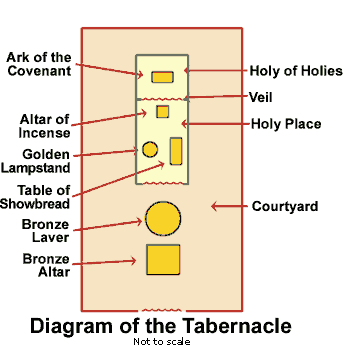
The above is a diagram of the tabernacle with all its sections in place. The following are scripture references to the different sections of the tabernacle if you chose to look further into it.
  • Main Altar/Alter of Offerings - Exodus 27:1-8
  • Lavar/Basin of Water - Exodus 30: 17-21
  • Holy Place - Exodus 26:33
  • Table of Shewbread - Exodus 25: 23-38
  • Candlestick/Menorah - Exodus 25: 31-40
  • Altar of Incense - Exodus 30: 1-10
  • Veil - Exodus 26:33
  • Ark of Covenant - Exodus 25:10-22
  • Holy of Holies - Exodus 25:22
Ark of Covenant - Only authorized people were allowed to touch the Ark (Ex. 25:10-22) Inside were stone tablets containing the law written by the Lord. The lid represents the presence of God and is the Mercy Seat. Once a year, high priest would enter the Holy of Holies and perform his ordinance at the mercy seat to make atonement for the people (Leviticus 16).
What did the Lord say to Moses about the mercy seat? (Exodus 25:22)
  • The Lord told Moses that He would meet him and commune with him above the mercy seat. Moses is to receive more direction for his people here.
Table of Shewbread - (Exodus 25:23-30) Bread was changed each Sabbath day and eaten by priests. Jewish tradition had that there also be wine placed on the table (although this is not directly written in scripture. What can bread (and wine if it was there) represent?
  • We believe the bread/wine to represent the body and blood of our Savior.
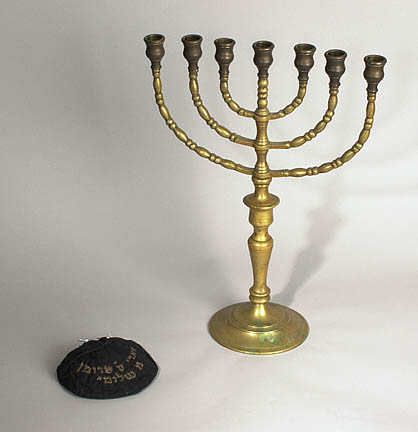
Sacred candlestick/lampstand - (Ex. 25: 31-40) Frequently called a menorah. The seven candle cups (seven is many times used in the bible to represent completion/perfection) were filled with olive oil, a wick was placed in it and lit. The parable of the 10 virgins can give us a small idea of what this might represent. What do you think?
  • We think this could possibly be a means of telling all to be prepared. To light your lights and find your way to God. Because, 'ye know neither the day nor the hour wherein the Son of man cometh.' (Matt 25:13) The 5 wise virgins had their oil for their lamps and hence were ready when their bridegroom came.
  • Also we feel the candlestick to represent living by the light of the spirit. This is alongside the table of shewbread to represent living by his flesh as well. Live by the light and flesh of Christ!
Altar of burn offerings/Main Altar - All burnt offerings were performed on the altar (Exodus 27:1-8). Sacrifice was the first thing an individual did when entering into the tabernacle (if we wanted to progress further) What do you think the Altar represents?
  • The altar represents sacrifice. In order for us to continue to grow and become closer to God, we must be in obedience and sacrifice (Romans 12:1) We must place the animal within us on the altar!
Altar of incense - Hot coals were placed on the altar of incense (Ex. 30:1-10) each morning and each evening when the high priest burned the incense. Read Psalms 141:2, Revelation 5:8, Revelation 8:3-4 and explain what this might represent.
  • In our opinion the incense represent prayer. Prayer can only take us closer to God.
Lavar/Water Basin - Priests used the lavar for washing (Ex 30:18-21) in preparation for entering the holy places of the tabernacle. What do you think the Lord was trying to teach His people by putting the lavar in front the entrance to the holier places of the tabernacle?
  • We believe that this means we must cleanse ourselves of all unrighteousness as we come closer to God. The lavar may also represent baptism.

Its amazing the symbolism the Lord uses to teach His people. Everything has a deeper significance. These are things we can apply in our daily lives as we strive to reach our Lord and Savior.

Mar 31, 2010

WORD Wednesday III


Exodus 24

Key Terms
  • One voice (v.3) - in unity
  • Behold (v.8) - This is..
  • Nobles (v.11) - chief men/leaders
  • "He laid not his hand" (v.11) - God did not hurt the Israelites (did not lay his strength/power)
  • Minister (v.13) - servant/helper
1. After Moses gave the people God's laws, what did they covenant to do? (Exodus 24:3-8)
  • The people answered on one accord and said "All the words which the Lord hath said will we do." They also offered burnt offerings, and peace offerings. Moses then re-read the book of the covenants, and the people once more agreed to do and be obedient through a blood covenant.
2. According to Exodus 24:9-11, what happened to the 70 elders in Israel because they made this covenant?
  • The answer is best described in v. 10 "they saw the God of Israel." God did not lay his hand on them, and instead they ate and drank. At this point in our bible study discussion, Keith envisioned himself sitting at a table in heaven, eating a nice, big, juicy, steak, while God asked him if he needed anything. LOL
3. What has the Lord promised will occur as you make and keep covenants with Him?
  • We feel like the best answer for this question lies in Luke 11:28, "But he said, Yea rather, blessed are they that hear the word of God, and keep it." We can relate this with what has happened to Moses and the Israelites, "And the glory of the Lord abode upon mount Sinai..." Exodus 24:16 How awesome is that?
  • What a blessing it is to make promises to our Lord and Savior, and keep those promises, not only do we owe it to God, but know in the end the righteous will not be forsaken.

Mar 24, 2010

WORD Wednesday II


Exodus 20 - The Commandments

1. Key Terms -
  • Graven (v.4) - carved, chiseled, created
  • Iniquity (v. 5) - sin
  • Vain (v. 7) - for no worthy purpose, emptiness
  • Covet (v. 17) - crave, wish, long for, desire
  • Hewn (v. 25) - cut, fitted
2. There are two commandments that tell us what we SHOULD do. The other commandments tell us what NOT to do. We can receive guidance by looking at each of those commandments and writing them as a "thou shalt" phrase, to see ways in which we can keep each commandment. For example, "Thou Shalt Not Kill" to "Thou shalt bring life"
  • Keith and I had fun with this one! We will share a few:
  • "Thou shalt not steal" - "Thou shalt give!"
  • "Thou shalt not bear false witness" - "Thou shalt speak truth"
  • "Thou shalt not covet..." - "Thou shalt be joyful for thy neighbor's blessings"
  • We loved doing this little exercise. It shows us how liberating the Gospel of Christ really is. It is often said that Christianity is far too strict, and allows for little movement, but with such an exercise we see how much we CAN do.
3. Which of the Commandments do you think the world needs to pay more attention to today? Why?
  • "Thou shalt not commit adultery" - It seems like nowadays people are not taking the covenant of marriage seriously. Many are allowing their weak flesh to take control of their actions. We have many examples of this at the moment, and chose not to speak of names.. but nonetheless, feel this is a commandment that is taken very lightly in today's society.
4. What did the children of Israel do after hearing and seeing the things in Exodus 20: 18-21? Why do you think some people choose to not get any closer to God or to draw away from Him?
  • The children of Israel removed themselves, and stood afar off. They feared the presence of God.
  • We had a good discussion in regards to this last question. In our opinion, people fear judgment. People feel conviction. They take offense to these things, and take a step back. People do not want to face the Lord for fear of having done wrong, and are not ready to make the necessary steps to make things right with God.

Please share your answers! We would love to hear your thoughts!

Mar 17, 2010

WORD Wednesday


It's been difficult to find things to blog about on a consistent basis. One thing that does remain consistent in our lives is scripture reading. We wanted to give you guys a taste of our Bible study here in the Spencer household with our new weekly segment, WORD Wednesday.

We are currently in the process of reading the Bible in chronological order, and are in Exodus at the moment. Our chapter today was Exodus 15. We will place some key terms and questions on the blog in hopes of aiding you in your scripture study!

Exodus 15

1. Key Terms to Understand -
  • Murmuring (v.24) - complaining
  • Ordinance (v.25) - Law
  • Statute (v. 25 & 26) - Commandment/Law
  • Proved (v.25) - Tested/established.. we thought either fit well
2. What is your favorite gospel hymn/song? The Israelites were happy and grateful so they sang. Which hymn/song helps you feel closer to God? Why?
3. Exodus 15:22-27 Compare what the people did and what Moses did when they realized there was no water. What can we learn from the different ways Moses and the people responded to this?
  • The people responded by murmuring/complaining about their situation. Moses went straight to Lord. We learn here that complaining gets no response, and through prayer, Moses was shown his answer.
4. Explain what spiritual meaning the physical experience at Marah could possibly have.
  • We went into a good discussion on this one. The Israelites were literally in a bitter situation. Much like ourselves at times. Only was it through prayer that they received an answer for that bitterness. The Lord gave them something sweet (the tree) to make those bitter things sweet. This is much like the atonement of Christ, in that in our lives in this flesh, we are given the Only Begotten Son to forgive us of those bitter things (sin) in life. Now isn't that sweet? lol...
This concludes our WORD Wednesday segment for this week. Stay tuned for next week on another chapter in Exodus.

Please share with us your thoughts, answers, other key terms we could have discussed, etc.